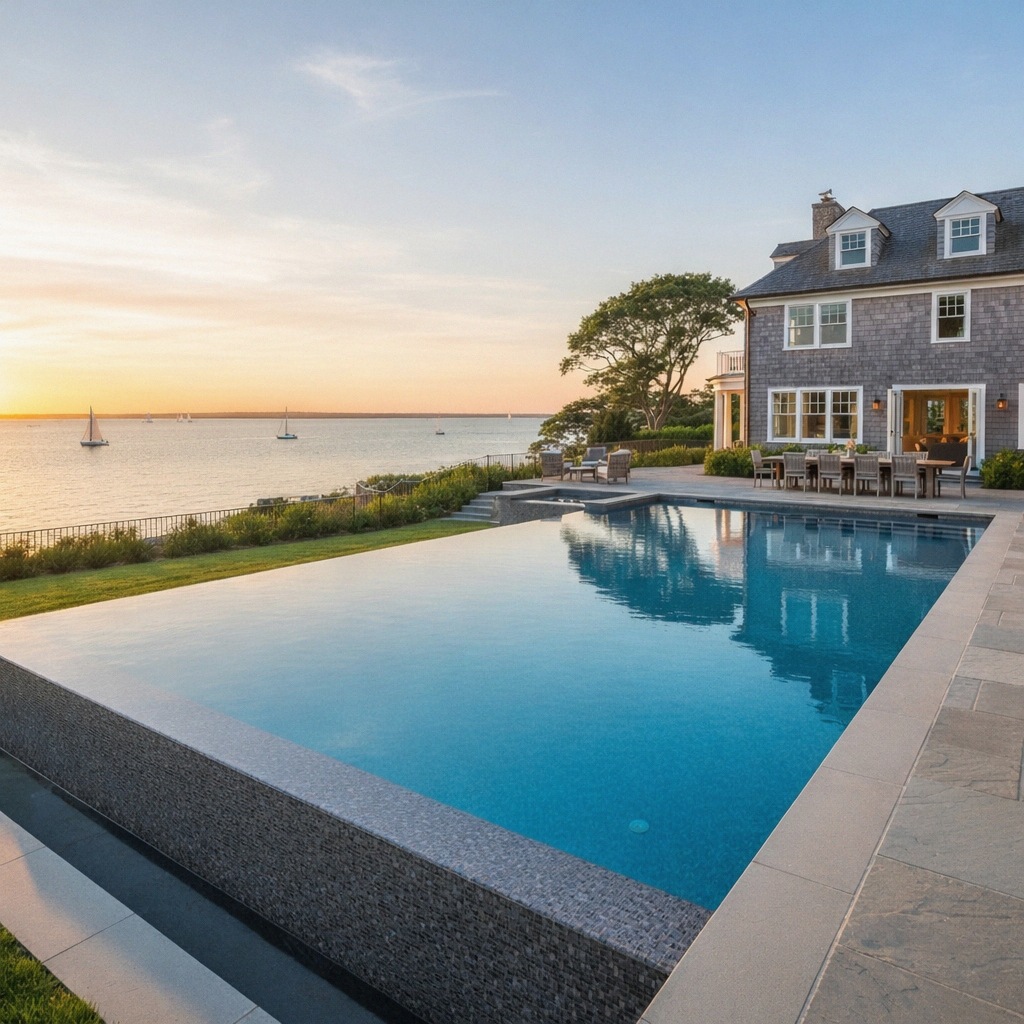
Vanishing edge merging with Long Island Sound at golden hour on a Gedney Pools custom gunite pool
GEDNEY POOLS
DARIEN, CONNECTICUT
VANISHING EDGE POOLS
The Borrowed Horizon

The Hydraulic Engineering of a Vanishing Edge

FOURTH-GENERATION POOL BUILDERS. DARIEN, CONNECTICUT.

GEDNEY POOLS
02 / 14
THE ILLUSION AND THE MACHINE

The eye sees water meeting sky. The image is held up by a machine built to disappear.

A vanishing edge sends the pool's water over a precisely leveled edge into a concealed basin below, so the surface appears to pour into the landscape: into the Sound, a valley, or the sky itself.

It is the most demanding structure in residential pool construction. The margin for error is a sixteenth of an inch, and every failure is loud, visible, and expensive.

The illusion is optical. The discipline behind it is hydraulic.

GEDNEY POOLS
03 / 14
THE SYSTEM, ENTIRE

One Pool the Guest Sees. Two the Builder Builds.

TERRACE MAIN POOL THE WEIR LEVEL TO 1/16 IN THE FALLING SHEET THE CATCH POOL A SECOND ENGINEERED VESSEL, CONCEALED DEDICATED EQUIPMENT RETURN, ENGINEERED TO THE EDGE THE VIEW BEYOND ILLUSTRATIVE DESIGN SECTION, NOT A CONSTRUCTION DOCUMENT
GEDNEY POOLS
04 / 14
THE TOLERANCE
1/16 in

The weir is a precision-formed edge, laser-leveled to within a sixteenth of an inch across its entire length, whether that length is twelve feet or eighty.

Water crosses it in a thin, even sheet. An unlevel edge breaks the sheet into streams, breaks the illusion, and makes noise. This is where inexperienced builders fail.

THE EDGE, LEVEL AND NOT LEVEL: ONE UNBROKEN SHEET UNLEVEL: STREAMS, GAPS, NOISE DRY REACHES BETWEEN STREAMS ILLUSTRATIVE DESIGN SECTION, NOT A CONSTRUCTION DOCUMENT
GEDNEY POOLS
05 / 14
THE SECOND POOL

The Pool You Never See Is the One That Decides

Every drop that crosses the edge lands in a second vessel: the catch pool, concealed below the weir, with its own dedicated equipment and a return engineered to the specific edge it serves. Sizing it correctly is one of the defining problems of this structure: it must absorb a full pool of bathers and a hard rain at once. The calculation stays with the builder.

SIZED TOO SMALL, THE USUAL FAILURE
The system overflows

A crowded pool displaces water over the edge, a storm adds its own, and an undersized basin gives it all back onto the hillside. Water on the ground, and the owner watching it happen.

STARVED OF RESERVE
The system runs dry

The catch pool is also the system's only reserve. If the return pump can empty it faster than the sheet refills it, the pump pulls air instead of water, and a starving pump is loud, destructive, and expensive.

Both failures are loud, visible, and expensive. Neither has ever been fixed by a product.

GEDNEY POOLS
06 / 14
THE SHEET

The Sheet Should Whisper

A vanishing edge at its best carries a quiet, controlled sheet: enough water to hold one unbroken film of light across the weir, and no more.

A heavy sheet multiplies evaporation, and the wind catches it and carries water clean past the catch pool. The Niagara look costs the owner twice: once in heat, once in water.

Variable-speed control puts the edge on a dial, from a shimmer you hear only standing beside it to a full cascade for the evenings that call for drama.

Matching the pump, the return, and the weir so the dial behaves is the builder's craft, and it stays there.

Drama on demand. Discipline by default.

GEDNEY POOLS
07 / 14
OPERATING DOCTRINE

The Edge Does Not Run All Day

A running edge is heated, chemically balanced water handed to the sky. Beautiful, and billed monthly.

RUN IT FOR THE MOMENT

The sheet runs when you want the effect: the dinner hour, the swim, the view from the terrace.

A SHORT DAILY CYCLE

A brief scheduled run each day holds the main pool's level against normal evaporation. Minutes, not hours.

LEVEL, HELD EXACTLY

Electronic autofill holds both vessels at their exact lines automatically. Level discipline is what separates a working edge from a noisy one.

Builders who leave the edge running around the clock are burning the owner's heat and chemistry. Ours do not.

GEDNEY POOLS
08 / 14
THE CONFIGURATIONS

Three Ways to Vanish

ONE EDGE, THE LONG FAR SIDE

The single edge

The classic form: the long far side dissolves into the view. The most cost-effective way to borrow the horizon, and the end walls stay solid for the automatic cover.

TWO CONNECTING EDGES

The double edge

The long side and a connecting end vanish together and the corner dissolves into the view. A larger basin system, and the automatic cover keeps its solid end wall.

ALL FOUR SIDES

The perimeter overflow

Every side is a weir and the pool reads as a freestanding body of water with no visible containment. The most extensive basin system, for the most ambitious projects.

GEDNEY POOLS
09 / 14
THE SITE MAKES THE POOL

The Edge Is a Frame for the View

Yards that slope away from the house toward Long Island Sound, the hills, or a wooded valley.

Lots with significant grade change, where the basin tucks naturally below the edge.

Waterfront properties, where the pool's edge merges with the water beyond it.

Any lot with a clear sightline past the edge. The water leads the eye to whatever the land offers.

The pool does not compete with the view. It hands you to it.
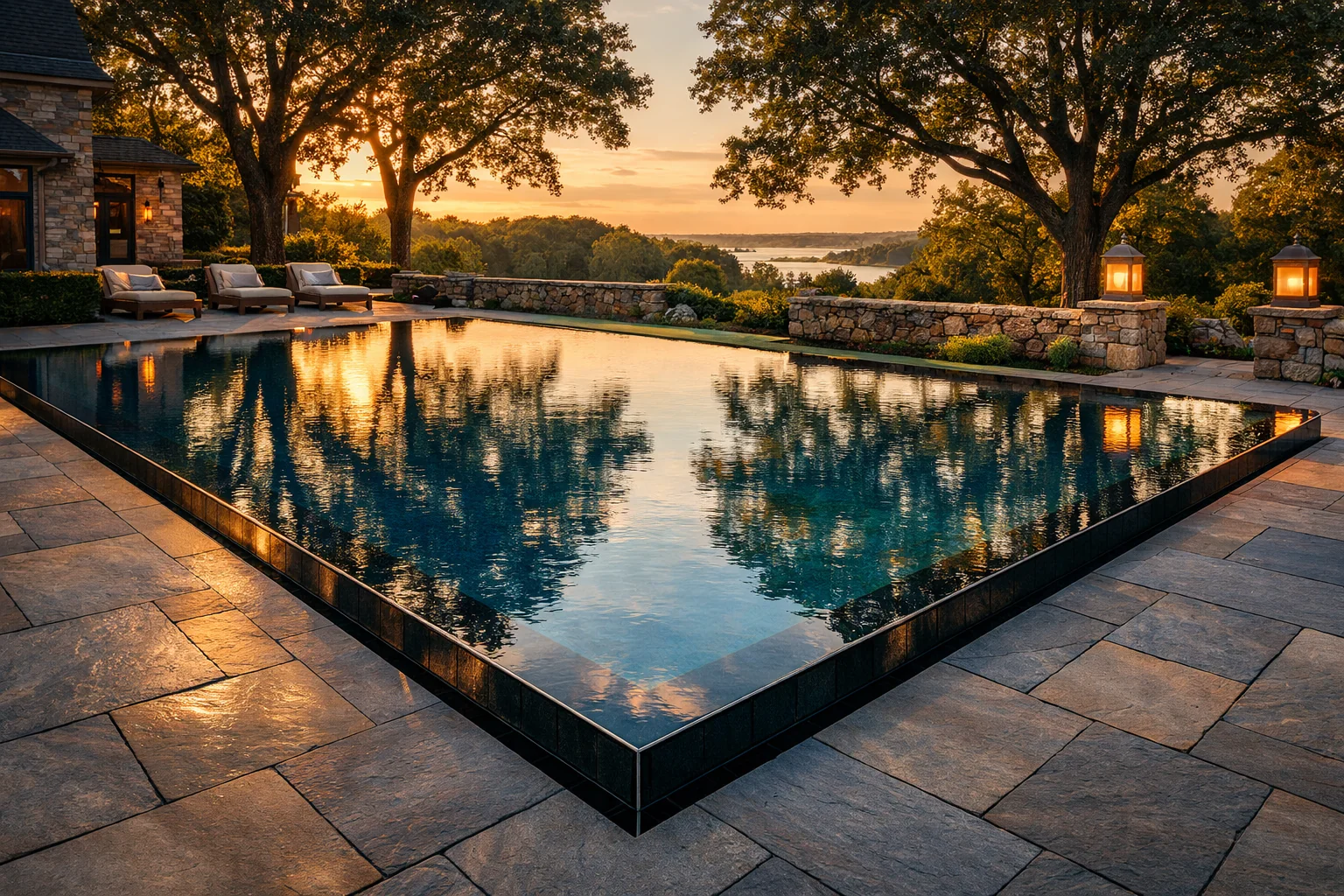
Perimeter overflow wet edge pool at golden hour, water flush with the bluestone deck, lake view beyond
GEDNEY POOLS
10 / 14
THE FLAT-LOT ANSWER

No Slope. Make One.

A vanishing edge does not require a hillside. On level ground the pool rises two to four feet above grade on structural walls, and the edge becomes a spatial statement: a horizon line made rather than found.

The raised shell is clad in the property's stone, the sheet falls into a concealed basin at its foot, and the flat yard gains the one thing it never had: an edge to look past.

RAISED SHELL ON LEVEL GRADE LEVEL GRADE POOL, RAISED CONCEALED BASIN 2 TO 4 FT ABOVE GRADE ILLUSTRATIVE DESIGN SECTION, NOT A CONSTRUCTION DOCUMENT
GEDNEY POOLS
11 / 14
FIELD NOTES

What the Wrong Builder Builds

The edge that never stops

Plumbed into the main circulation with no dedicated edge system, the sheet runs around the clock, and the owner pays for it in heat and chemistry, every month.

The Niagara sheet

An edge pushed like a waterfall multiplies evaporation, and the wind lifts the sheet and carries water clean past the catch pool and onto the hillside.

The pool that drains itself

Built wrong, the system can quietly send the pool's own water away through the catch pool, and the owner discovers it on the water bill.

The edge you can hear

An unlevel weir breaks the sheet into streams and gaps. The illusion is gone, and in its place is noise.

None of these are product problems. They are builder problems. This is a structure that punishes inexperience.

GEDNEY POOLS
12 / 14
THE DISCIPLINE

Engineering Before Excavation

The ground first

A detailed site survey opens every project: topographic measurement and soils analysis, because the basin and the walls answer to the ground they sit in.

Hydraulics before ground is broken

The hydraulic engineering is complete before excavation begins. Nothing about the edge is solved in the field.

Specialists, not generalists

Laser leveling and precision forming to the sixteenth-inch tolerance, gunite crews working tighter than standard pools, and structural and hydraulic engineers who specialize in residential pools. Permits and certifications are carried by the builder.

14 to 20 weeks

Excavation to completion runs longer than a standard build. The basin is a second structure, the plumbing is doubled, and the precision work is not hurried.

Four generations of pool builders, building these systems in Connecticut since they first became viable residentially.

GEDNEY POOLS
13 / 14
HONEST NUMBERS

What the Horizon Costs

TYPICALLY FROM
$250,000

A single-edge system on a favorable site, engineered and built to the tolerance the illusion demands.

COMPLEX MULTI-EDGE, HILLSIDE
$600,000+

Double edges and perimeter overflows on challenging grades, with the structure to hold them there.

The premium buys the second pool, its dedicated pump systems, the structural engineering and retaining walls, and the leveling that makes the water disappear.
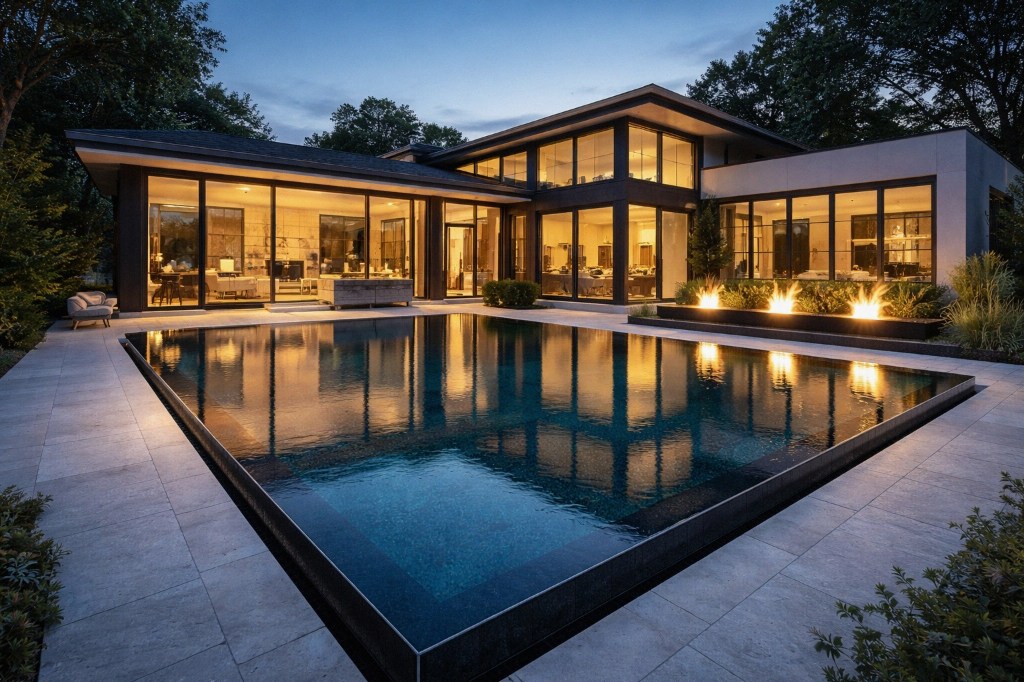
Lit vanishing edge line against dark water and sky at dusk
GEDNEY POOLS
14 / 14

The horizon, borrowed nightly.

Gedney Pools LLC | Darien, CT | (203) 302-9920 | CT HIC #0704131 | CT SPB #SPB.0000169

Vanishing Edge & Infinity Pool Design and Construction

The most dramatic pool type in residential construction. Engineered precision meets breathtaking aesthetics - where water meets sky on Connecticut's finest hillside estates.

What Is a Vanishing Edge Pool?

A vanishing edge pool - also called an infinity pool, negative edge, or disappearing edge - is the most technically demanding and visually stunning type of residential pool construction. Water flows over one or more precisely leveled edges, cascading into a concealed catch basin below, creating the illusion that the pool extends endlessly into the landscape. When built correctly on the right property, the effect is nothing short of breathtaking.

This is our premium specialty at Gedney Pools. Building a vanishing edge pool that actually works - consistently, quietly, beautifully - requires a level of hydraulic engineering, structural design, and construction precision that most pool builders simply cannot deliver. Our family has been engineering and building these systems in Connecticut since the technology first became viable in residential construction, and we bring four generations of accumulated expertise to every project.

Vanishing edge pools are not just pools with a fancy edge. They are complex water management systems shaped by wind, weather, structure, and use - engineered exactly, and engineered to look effortless. That combination of invisible complexity and visible beauty is exactly what we specialize in.

Investment Range: Vanishing edge pools in Fairfield County typically start at $250,000 and range to $600,000+ for complex multi-edge designs on challenging hillside lots. The premium over a standard gunite pool reflects catch basin construction, secondary pump systems, structural engineering for retaining walls, and the precision leveling required for a flawless vanishing edge.

How Does a Vanishing Edge Pool Work?

Understanding the engineering helps you understand why these pools cost more and why builder selection matters so critically:

The Edge. The vanishing edge itself is a precision-formed weir - a wall built to an exact elevation, typically within 1/16 of an inch across its entire length. Water flows over this edge in a thin, even sheet. If the edge is not perfectly level, the water sheet will be uneven, breaking the visual effect and creating noise. This is where most inexperienced builders fail.

The Catch Basin. Below and behind the vanishing edge sits the catch basin (also called a surge tank or balance tank). This is essentially a second pool - a reinforced concrete vessel engineered to the specific pool and edge it serves, with its own dedicated equipment. Size it wrong and the system overflows or runs dry. Both failures are loud, visible, and expensive, and both are common on inexperienced builds.

The Return System. One or more dedicated pumps in the catch basin continuously return water to the main pool. These pumps are engineered to the specific edge they serve. Variable-speed pumps allow us to adjust the edge effect from a gentle shimmer to a dramatic cascade, giving the homeowner control over the visual presentation.

The Autofill. Because vanishing edge pools lose more water to evaporation and wind than standard pools, a robust autofill system is essential. We install commercial-grade autofill controllers that maintain exact water levels in both the main pool and the catch basin.

Which Properties Are Ideal for Vanishing Edge Pools?

The most dramatic vanishing edge installations take advantage of natural topography. Properties throughout Fairfield County that are ideal for this treatment include:

  • Hillside lots in Greenwich and New Canaan: Backyards that slope away from the house, especially those with views of Long Island Sound, distant hills, or wooded valleys
  • Elevated properties in Ridgefield and Weston: Lots with significant grade changes that create natural elevation for the vanishing edge effect
  • Waterfront estates in Darien and Westport: Pools overlooking harbors, rivers, or the Sound where the water edge can visually merge with the distant water
  • Properties with panoramic views: Any lot where there is a clear sightline beyond the pool edge - the vanishing edge serves as a frame for the view

Even relatively flat properties can accommodate a vanishing edge by building up one or more sides of the pool with structural walls, creating an artificial elevation change. We have built striking vanishing edge pools on flat lots by raising the pool 2-4 feet above grade, creating a visual and spatial statement that transforms the entire backyard.

Single Edge vs. Multi-Edge: Which Vanishing Edge Design Is Right?

Single vanishing edge is the most common configuration - one side of the pool (typically the far side from the house) has the vanishing edge while the other three sides have traditional coping. This is the classic infinity pool look and the most cost-effective vanishing edge design.

Double vanishing edge features two opposing sides with vanishing edges, creating a dramatic floating-water effect. This works beautifully on lots with views in two directions and requires a larger catch basin system to handle the increased water volume.

Perimeter vanishing edge - all four sides overflow - is the most technically complex and visually spectacular option. The pool appears to be a freestanding body of water with no visible containment. This design requires the most extensive catch basin system and is typically reserved for the most architecturally ambitious projects.

Why Choose Gedney Pools for Your Vanishing Edge Build?

This is not a project to hand to a builder who has done one or two infinity pools. The margin for error is measured in fractions of an inch, and the consequences of poor engineering - uneven edge flow, noisy cascades, catch basins that overflow or run dry, pump systems that cavitate - are expensive to fix and impossible to hide.

  • Proven track record: We have designed and built vanishing edge pools throughout Fairfield County on every type of terrain, from gentle slopes to severe hillside lots requiring extensive retaining wall systems
  • In-house engineering: We work with structural and hydraulic engineers who specialize in residential pool construction - not general civil engineers doing a pool project for the first time
  • Precision construction: Our gunite crews understand that vanishing edge walls require tighter tolerances than standard pool construction. We use laser-leveling and precision forming to achieve the 1/16-inch edge tolerance these pools demand
  • System integration: We handle all mechanical, plumbing, and automation integration so the vanishing edge, main pool circulation, spa (if applicable), and water features all work together seamlessly through a single control system

What Is the Vanishing Edge Pool Construction Timeline?

Vanishing edge pools typically take 14 to 20 weeks from excavation to completion - longer than a standard gunite pool due to the catch basin construction, additional plumbing systems, and precision requirements. The design phase also takes longer because the hydraulic engineering must be completed before construction begins.

We begin every vanishing edge project with a detailed site survey, including topographic measurements, soil analysis, and a thorough assessment of the natural grade. This information feeds directly into the structural and hydraulic engineering that determines catch basin size, pump specifications, edge geometry, and retaining wall requirements.

Permitting for vanishing edge pools can be more involved than standard pools because of the additional structure (catch basin, retaining walls) and the potential impact on drainage patterns. We handle all permit applications and engineer's certifications as part of our service.

Frequently Asked Questions

Vanishing Edge Pool FAQ

Water flows over one or more edges into a concealed catch basin (surge tank or trough) below. A secondary pump continuously returns water to the main pool, creating the illusion that water extends to the horizon. The system requires exacting hydraulic and structural engineering, and an edge that is perfectly level.

Vanishing edge pools in Fairfield County typically start around $250,000 and can exceed $600,000 for complex multi-edge designs on challenging hillside lots. The premium over a standard gunite pool reflects the catch basin construction, additional pumping systems, structural engineering, and precision required to build a flawless vanishing edge.

Vanishing edge pools work best on properties with grade changes - hillsides, sloped backyards, or elevated lots with views. However, vanishing edges can also be built on relatively flat properties by creating artificial elevation changes with retaining walls and berms. We evaluate every property during our site consultation and advise on what will look and function best.

Vanishing edge pools need additional pump horsepower to circulate water between the catch basin and the main pool, adding modestly to energy costs. Evaporation is slightly higher because of constant edge water movement. With a properly sized autofill and variable-speed pumps, the operating cost is $30-60 per month more than standard.

In most cases, a vanishing edge cannot be retrofit to an existing pool because the structural shell, plumbing, and site grading were not designed for it. The catch basin must be engineered as an integral part of the pool structure. If you have an existing pool on a sloped lot and want a vanishing edge, the most effective approach is a complete tear-out and rebuild, which we handle as part of our pool renovation services.

Envision Your Infinity Pool

Let us visit your property and show you what is possible. Free on-site consultation for vanishing edge projects throughout Fairfield and Westchester County.

(203) 302-9920
Email Us