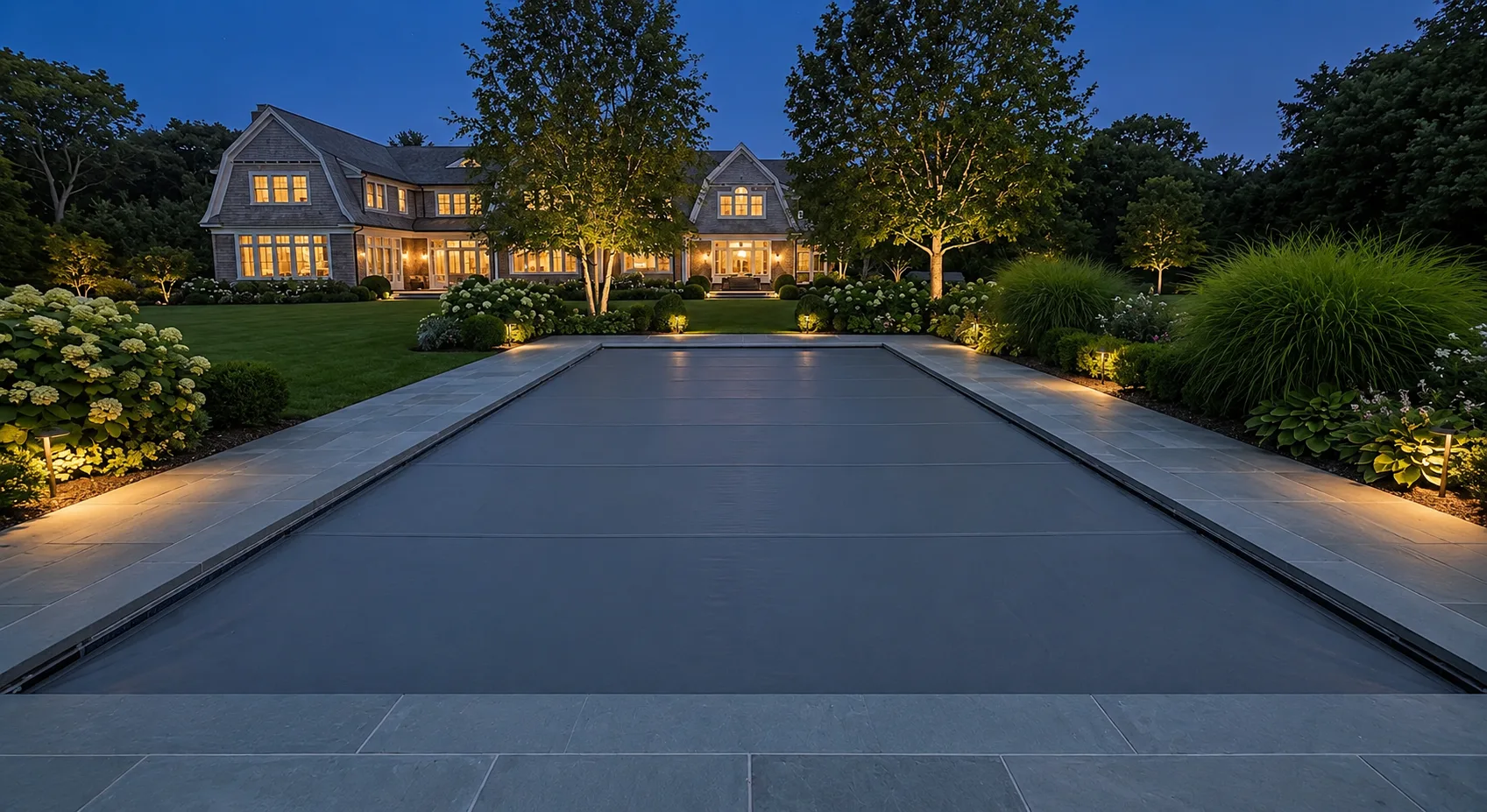

Automatic pool cover integrated flush into bluestone coping on a Gedney Pools custom gunite pool at twilight
GEDNEY POOLS
DARIEN, CONNECTICUT
AUTOMATIC POOL COVER SYSTEMS
The Vanishing Cover

The Engineering of an Automatic Pool Cover That Nobody Sees

FOURTH-GENERATION POOL BUILDERS. DARIEN, CONNECTICUT.

GEDNEY POOLS
02 / 16
THE THESIS

A cover is not an accessory bolted onto a pool. It is three systems inside one enclosure.

I

A life-safety barrier

Rated to a static load standard, tested with water on it and a child beneath it. The fabric and the track carry weight, and the standard says how much.

II

A thermodynamic lid

Evaporation governs a pool's entire energy budget. The cover is the single variable with the largest effect on what the pool costs to run.

III

A piece of civil architecture

Vault, dam wall, track pocket, and drive offset are structural decisions. They are made on the shell drawing, before any concrete is placed.

On a $200,000+ asset, the cover is the component that decides whether the pool is safe, affordable, and beautiful at the same time.

GEDNEY POOLS
03 / 16
ASTM F1346

The Load Physics of a Safety Barrier

DEFLECTION UNDER 485 LB STATIC LOAD UNLOADED PLANE 485 LB APPLIED MASS Two adults and one child, rescue scenario DECK AND COPING DECK AND COPING WATER SURFACE HYDRAULIC SUPPORT BENEATH THE BARRIER 2 IN MAX CLEARANCE
485 lbs

Static load a compliant cover must support on pools wider than 8 feet. Below that width the threshold is 275 lbs.

30 min

Standing water must drain substantially within thirty minutes of rain stopping, so accumulated load is never carried indefinitely.

4 in

Outward deflection may not open vertical clearance beyond 2 inches, nor any gap that admits a 4-inch sphere.

GEDNEY POOLS
04 / 16
THERMODYNAMICS

Where the Heat Actually Goes

75 to 95%

of a pool's total thermal energy loss is evaporation. Conduction through the shell and radiation from the surface are rounding errors beside it.

1,048

BTU extracted per pound of water evaporated at a surface temperature of 80 to 82 degrees F. Every departing pound takes that heat with it.

ASHRAE MASS-TRANSFER EXPRESSION
W = (95 + 0.425v)(pwpa) / hfg
W
evaporation rate, lb per hour per square foot
v
air velocity at the water surface, ft per minute
pw
saturation vapor pressure at water temperature, in. Hg
pa
partial vapor pressure of ambient air at dewpoint, in. Hg
hfg
latent heat of vaporization, BTU per lb
GEDNEY POOLS
05 / 16
MODELED SEASON

The Northeastern Season, Calculated

SURFACE
18 x 36 ft
SURFACE WIND
1.0 to 1.2 mph
TARGET TEMPERATURE
82 degrees F
ACTIVE DAYS
123
May 15 to September 15
RESULT, UNCOVERED, ONE SEASON
21,619.5
GALLONS LOST

Water that has to be replaced, rebalanced, and reheated from the tap.

53.52 in
OF DEPTH

More than four and a half feet of water leaves the pool as vapor across the season.

188.96
MMBTU LATENT HEAT

Energy purchased and then released into the Northeastern sky.

GEDNEY POOLS
06 / 16
OPERATING ECONOMICS

Held Closed 83.3 Percent of the Time

UNCOVERED SEASON $9,154.21 85% LESS EVAPORATION THE BARRIER Closed 83.3% of every season hour 70% LESS NET HEATING COVERED SEASON $2,713.83 70.3% REDUCTION 4.7 YEAR PAYBACK
$3,456.61
GAS SAVED, 2,304.4 THERMS

The heater runs against a lid instead of an open surface.

$2,800.00
CHEMICALS SAVED, $4,000 TO $1,200

Roughly 70 percent less UV photolysis and volatile off-gassing.

$183.77
MAKE-UP WATER, 18,376.6 GAL

Water that never has to be added, balanced, or reheated.

Figures are modeled estimates for the simulation parameters on the preceding slide, at natural gas of $1.50 per therm, an 82 percent efficient heater, and water at $10.00 per 1,000 gallons. Actual results vary with utility rates, weather, pool size and depth, equipment, set temperature, bather load, length of season, and how consistently the cover is closed. Nothing here is a guarantee of savings.

GEDNEY POOLS
07 / 16
THE GEDNEY STANDARD

The Encapsulated Track

HOW WE BUILD
COPING, MORTARED CAST IN WATER

Under-track, encapsulated

THE METHOD

Cast into the pool wall as the shell is shot, concealed beneath the mortared coping.

THE RESULT

Part of the structure itself. Full rated load for the life of the pool, and invisible from above.

Engineered into the concrete before it is placed.

THE SHORTCUT
CANTILEVERED STONE SCREWED TO STONE

Under-track, screw-on

THE METHOD

Fastened to the underside of the coping stone after the fact, where the cover was an afterthought.

THE FAILURE MODE

Every storm parks its rainwater on the closed cover. That weight hangs on the screws, and screws set in stone eventually pull out.

We do not build this way.

GEDNEY POOLS
08 / 16
HYDRAULIC BALANCE

The Dam Notch: A Zero-Profile Leading Edge

SECTION AT DAM WALL. DRY VAULT LEFT, POOL RIGHT. REMOVABLE LID, SAME STONE AS THE COPING CONTINUOUS COPING COURSE HEAVY-DUTY ANGLE IRON OR STAINLESS STEEL BRACKETS DRY VAULT ROLL-UP TUBE LEADING EDGE BAR, INVERTED 2 IN NOTCH IN DAM WALL OPERATING WATER LEVEL 5 IN BELOW COPING 3 IN AIR GAP
THE AESTHETIC PROBLEM

A heavy leading-edge bar sitting exposed on the deck. It is the one part of the machine a guest would notice, and on a stone terrace it reads as equipment.

THE SOLUTION

A 2-inch recess cut into the vault dam wall. The bar parks upside down, flush, and the stone coping extends out over the notch to conceal it. The vault lid is the same stone as the pool coping, resting on heavy-duty angle iron brackets, stainless where the detail calls for it, so the whole run reads as one continuous course.

THE HYDRAULIC CONSTRAINT

The pool runs at a slightly lower operating level, engineered into the plumbing from the start. That preserves a 3-inch air gap at the dam wall, isolating the dry vault from wave displacement.

GEDNEY POOLS
09 / 16
THE VAULT LID

The Vanishing Stone Lid

SECTION THROUGH THE COVER VAULT AND DAM WALL. VAULT LEFT, POOL RIGHT. REMOVABLE LID STONE, SAME AS THE COPING POOL COPING, MORTARED IN PLACE 1 2 18 IN STEEL BRACKET ROLL-UP TUBE DRY VAULT COVER BAR IN THE 2 IN NOTCH 6 IN WATERLINE TILE 3 OPERATING WATER LEVEL
1
Matching lid stone

The same 2-inch stone as the pool coping, cut to the vault width. It rests directly on the steel - no tray, no mortar.

2
18-inch steel bracket

Bolted to the vault wall, 3 to 3.5 feet on center, and bonded into the pool's equipotential grid.

3
The tiled dam wall

Notched 2 inches at the top of the pool face. The bar parks under the coping's overhang, waterline tile wraps the notch, and the wall reads like any other.

From the terrace, nothing announces the machine. The stones lift for service and set back without a trace.

CODE NOTE

Vaults drain to an approved disposal system through an air gap, never a direct sanitary sewer connection.

GEDNEY POOLS
10 / 16
THE CENTRAL MECHANICAL PROBLEM

The Differential Roll Paradox

START OF DEPLOYMENT
FABRIC ROLL, FULL CABLE REEL, EMPTY HIGH FABRIC PER TURN
END OF DEPLOYMENT
FABRIC ROLL, SPENT TAPERED REEL, WOUND WINDING PATH SHIFTS LATERALLY

As the cover deploys, the fabric roll shrinks and releases less linear fabric per rotation. At the same instant the cable reel grows and pulls more cable per rotation. The mismatch compounds with every turn, and on a system that ignores it the outcome is a snapped cable or a tangled cover.

The answer is a mathematically tapered cable reel. Its winding path shifts laterally along an increasing diameter, so linear velocity and rope tension stay synchronized from the first rotation to the last.

GEDNEY POOLS
11 / 16
TRANSMISSION AND DRIVE MEDIA

One Shaft, Two Directions

DRIVESHAFT ROLL-UP TUBE RETRACTION PATH SHIFTING DOUBLE DOG GEAR SLIDES TO ENGAGE EITHER SIDE SLIP CLUTCH TAPERED CABLE REEL EXTENSION PATH TO TRACK

The shifting gear

A double dog gear slides along the driveshaft to engage the roll-up tube for retraction or the cable reel for extension. One motor, two opposing jobs.

The clutch calibration

Electric systems use a mechanical slip clutch whose tension bolts are set in precise 1/8-turn increments. Overtightening burns the motor. Undertightening stalls the cover.

The drive media

Aircraft-grade stainless drive cable eliminates the stretch, shrinkage, and track misalignment that come with polymer rope.

GEDNEY POOLS
12 / 16
DRIVE ARCHITECTURES

What Turns the Tube

01

Premium hydraulic

Closed-loop pressurized fluid. It removes high voltage from the vault entirely and adjusts instantly to speed differentials without a slip clutch.

Requires remote pump-house plumbing.

02

Compact electric

A high-torque gear-motor with 1.5-inch pulleys and tapered reels. It fits an 11 to 14-inch offset, though load capacity limits it on spans past roughly 50 feet.

The practical choice for standard coping integration.

03

Standard electric

The legacy baseline: slip clutch and cylindrical reel, proven and widely serviced.

Requires a vault offset of 23 inches or more.

04

Miniature packaged

Low-voltage DC with short travel on surface track only. Suited to spas and plunge pools.

Cannot meet ASTM static loads on a full-size pool.

Control logic in each case is held to UL 60730-1 for automatic electrical controls.

GEDNEY POOLS
13 / 16
NEC ARTICLE 680

Equipotential Bonding: No Gradients Anywhere

EQUIPOTENTIAL GRID, #8 AWG SOLID COPPER MAXIMUM WATER LEVEL NEMA 3R JUNCTION BOX 5 FT HORIZONTAL BONDING ZONE 12 FT VERTICAL ENVELOPE LISTED PRESSURE LUG

Every metal part within 5 feet horizontally and 12 feet vertically of the maximum water level bonds to a single continuous grid. The purpose is to eliminate voltage gradients, so no two conductive surfaces a bather can touch sit at different potentials.

#8 AWG
minimum solid copper, joined by listed pressure lugs or exothermic welding.
4 ft / 8 in
junction boxes set 4 feet horizontally from the water, 8 inches above maximum water level, and 4 inches above finished grade.
NEMA 3R
enclosure rating for every outdoor box in the assembly.

Exempt: metallic cover anchors set in a concrete or masonry deck, 1 inch or less in any dimension and 2 inches or less in length.

GEDNEY POOLS
14 / 16
CONTROLS

Why the Switch Stays on the Wall

The design mandate is unobstructed visual supervision for the entire travel of the cover, because the hazard being engineered against is entrapment beneath a heavy vinyl membrane.

Every other requirement on this slide follows from that one sentence. The control is positioned, locked, and wired so that a person with eyes on the water is the only thing that can move the cover.

COMPLIANT
Momentary contact operation, requiring continuous human activation for the whole cycle.
Mounted at least 60 inches above grade, out of a child's reach.
Direct line of sight to the entire pool from the switch position.
Key or code lock on the control.
NOT COMPLIANT
Remote activation through voice assistants or phone routines. Automating the cover removes the supervising operator from the loop, which is a direct safety violation.
Any scheduled or triggered close, which introduces catastrophic risk if the system runs while the pool is occupied.

An app may report whether the cover is open or closed and log its use. The actuation itself stays local, momentary, and locked. Automation is welcome everywhere else in the equipment room.

GEDNEY POOLS
15 / 16
THE WINTERIZATION BOUNDARY

The Water Is What Holds It Up

An automatic cover has no innate structural rigidity. It relies entirely on the hydraulic support of the water beneath it. Cold-climate protocol lowers the water below the skimmers, and at that moment the cover is suspended rather than supported.

Under snow and ice a suspended cover converts vertical load into horizontal tension. Three things follow: track extraction from the coping, lateral wall collapse at the anchor line, and shearing of the fabric itself.

THE CONNECTICUT MANDATE

The automatic cover is cleaned, retracted fully into its dry vault, and disconnected from power. A dedicated tensioned mesh or solid spring-anchor cover carries the seasonal static load.

Overlooking a Gedney Pools infinity edge on Long Island Sound
GEDNEY POOLS
16 / 16
TOTAL INVISIBILITY

Mastery is balancing three sciences, then hiding the machine.

ASTM load physics, ASHRAE thermodynamics, and NEC Article 680 all have to be satisfied at once, inside a hostile New England microclimate, on a $200,000+ asset. Then the entire assembly has to disappear under a flawless finish.

Custom offset engineering

The vault sized to the shell, not the shell to the vault.

Zero-profile leading edges

The bar parked in a dam notch, below the stone line.

The vanishing stone lid

Coping stone bearing straight on bonded steel brackets.

The engineering exists to preserve the sanctuary.
Gedney Pools LLC | Darien, CT | (203) 302-9920 | CT HIC #0704131 | CT SPB #SPB.0000169

Custom Automatic Pool Cover Installation in Fairfield County, CT

Gedney Pools engineers ASTM F1346 load-rated automatic cover systems into new gunite construction and select renovations across Fairfield County, Connecticut and Westchester County, New York. The vault, the dam wall, and the encapsulated track are designed into the shell itself, so the finished pool shows stone, water, and nothing else.

At Gedney Pools, we believe a $200,000+ custom build deserves a cover that was never an afterthought. By solving the load physics, the thermodynamics, and the electrical code inside the concrete itself - and then hiding every trace of the machine beneath the stone you chose - we protect the people you love, the water you heat, and the sanctuary you built.

Cover the investment. Keep the view. Experience the Gedney Standard.

Gedney Pools LLC | Darien, CT | (203) 302-9920 | CT HIC #0704131 | CT SPB #SPB.0000169

Frequently asked questions

What is an automatic pool cover, structurally?

Three systems in one enclosure: a life-safety barrier tested to ASTM F1346 (485 pounds of static load on pools wider than 8 feet), a thermal lid that governs the pool's energy budget, and a piece of civil architecture - vault, dam wall, track pocket - designed into the gunite shell before concrete is placed.

How much does an automatic cover save on heating and chemicals?

In our modeled Northeastern season (18 x 36 pool, 82 degrees, 123 active days), holding the cover closed 83.3 percent of the time cut total seasonal operating cost from $9,154 to $2,714 - roughly 70 percent, about $6,440 per season across gas, chemicals, and make-up water. These are modeled estimates; actual results vary with utility rates, weather, pool size, equipment, set temperature, bather load, and how consistently the cover is closed.

Can I open the cover from my phone or a voice assistant?

No, by design. An app may report whether the cover is open or closed, but actuation stays at a keyed, momentary wall switch with direct line of sight to the whole pool. The hazard being engineered against is entrapment beneath a heavy vinyl membrane, so a supervising operator is never removed from the loop.

Will we actually see the cover?

Not on a Gedney pool. The track is cast into the shell and concealed beneath mortared coping, the leading-edge bar parks in a 2-inch notch below the stone line, and the vault lid is cut from the same stone as the coping, resting on steel brackets. From the terrace, the coping course simply continues.

What happens to the cover in a Connecticut winter?

It retracts fully into its dry vault and is disconnected from power. An automatic cover relies on the hydraulic support of the water beneath it, so a dedicated tensioned mesh or solid spring-anchor cover carries the seasonal snow and ice load instead.

Can an automatic cover be added to an existing pool?

Cover integration is at its best when engineered into new construction, where the vault and encapsulated track are formed with the shell. Select renovations can be adapted - see our pool renovation service for what your existing structure allows.

Serving the Gold Coast & Westchester

The Invisible Standard in Pool Safety

Call (203) 302-9920, email info@gedneypools.com, or request a consultation to specify The Vanishing Cover on your new build or renovation. Related reading: Premium Water Care keeps cover hardware out of corrosive chloride environments.

Gedney Pools LLC • Darien, CT 06820 • CT HIC #0704131 | CT SPB #SPB.0000169 • Verify at elicense.ct.gov