Serving all of Fairfield County. Gedney Pools builds across the county, from the Gold Coast shoreline to the northern towns. See the luxury pool builder in Fairfield County, CT overview, or read on for what building in Wilton specifically involves.
Pool Construction in Wilton's Private Landscape
Wilton occupies a particular niche on Connecticut's Gold Coast. While its neighbors Westport and Norwalk offer coastal access and Stamford provides urban energy, Wilton is defined by its interior character -- 27 square miles of rolling, wooded hills dissected by the Norwalk River and its tributaries. The town's 18,000 residents live on properties that feel genuinely rural despite being 50 miles from Midtown Manhattan. Stone walls line roads named for the colonial families who built them. Mature white oaks, sugar maples, and white pines create a canopy that gives the town an enclosed, private feeling impossible to replicate on the open terrain of the coastal towns.
This landscape creates ideal conditions for a very specific kind of pool construction. Wilton pools exist within their environment, not imposed upon it. They are screened by trees, framed by native stone, and sited to take advantage of the terrain rather than fight against it. Gedney Pools LLC understands this sensibility. With decades of pool construction experience and a commitment to custom gunite construction, we build pools in Wilton that belong on their properties. CT HIC #0704131, CT SPB #SPB.0000169.
Wilton's Neighborhoods and Pool Opportunities
Wilton Center, clustered around the intersection of Ridgefield Road (Route 33) and Danbury Road (Route 7), serves as the town's commercial hub. The residential areas radiate outward in every direction, each with its own topographic character:
Cannondale: The historic village of Cannondale, along the Norwalk River in the southwestern portion of town, features a mix of renovated antique homes and newer construction on lots that range from one to several acres. The river valley setting provides relatively flat terrain near the water with steeper grades on the hillsides above. Pool designs here often work with the grade transitions, placing pools on natural terraces carved into the hillside.
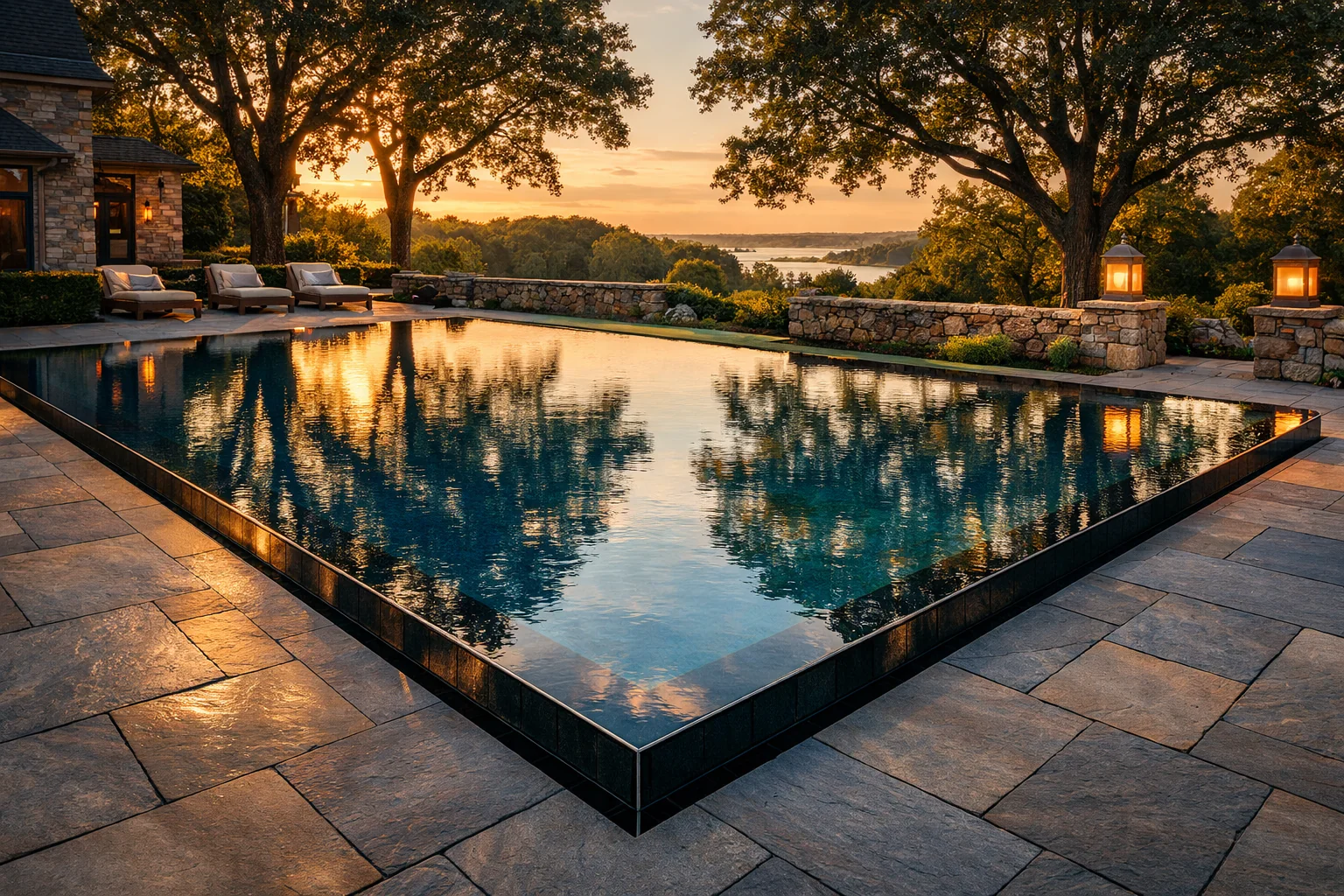
Georgetown: Wilton's northern section near the Redding and Weston borders is the most rural part of town. Properties along Olmstead Hill Road, Cannon Road, and the roads surrounding the Georgetown section sit on large lots with significant tree cover. The privacy of these properties allows for pool designs that would feel exposed on more suburban sites -- naturalistic pools surrounded by boulders and plantings, vanishing edge installations overlooking wooded valleys, and expansive pool terraces that serve as true outdoor living rooms.
Drum Hill and Belden Hill: These central Wilton neighborhoods, served by roads like Drum Hill Road, Belden Hill Road, and Cheese Spring Road, feature classic Fairfield County residential properties on two-acre lots. The terrain is hilly with intermittent rock outcroppings, and the homes range from renovated colonials to substantial new construction. This area sees strong demand for pools that complement traditional architecture while delivering modern functionality.
Silvermine (Wilton section): The Silvermine neighborhood crosses into Wilton from Norwalk and New Canaan, and the Wilton portion shares the same artistic, naturalistic character. Properties along Silvermine Road and its branches are heavily wooded with the Silvermine River as a defining landscape element.
Terrain, Soil, and Construction Considerations
Wilton's geology presents both challenges and opportunities for pool construction. The town sits on glacially deposited soils overlying bedrock that comes close to the surface in many areas. Rock excavation is a frequent requirement, particularly on the hilltops and ridgelines where many of the finest properties are located. Gedney Pools has extensive experience with rock work and treats rock as a possibility on every hilltop site, priced when it is encountered rather than guessed at in advance.
Wetlands are widespread in Wilton, given the Norwalk River watershed and the numerous streams and ponds throughout town. The Wilton Inland Wetlands Commission regulates construction activity within 100 feet of wetlands and watercourses, and pool construction within these areas requires a formal application and public hearing. The commission meets regularly, and application review typically takes 4 to 8 weeks.
On difficult pool sites in Wilton, CT, we cover the full permit path: wetlands and watercourse buffers where they apply, coastal or flood-zone review where relevant, septic and well separation, steep slopes, ledge, drainage, lot coverage, historic or architectural review, and variance coordination. Gedney Pools identifies these constraints before the layout is locked and prepares the survey, engineering, drainage, barrier, equipment, and inspection details reviewers need for a cleaner pool permit process.
Lot sizes in most Wilton residential zones provide ample room for pool construction, and setback requirements are generally manageable. Wilton's Planning and Zoning Commission sets pool setback requirements that vary by zone, typically requiring 15 to 25 feet from property lines.
Pool Designs That Work in Wilton
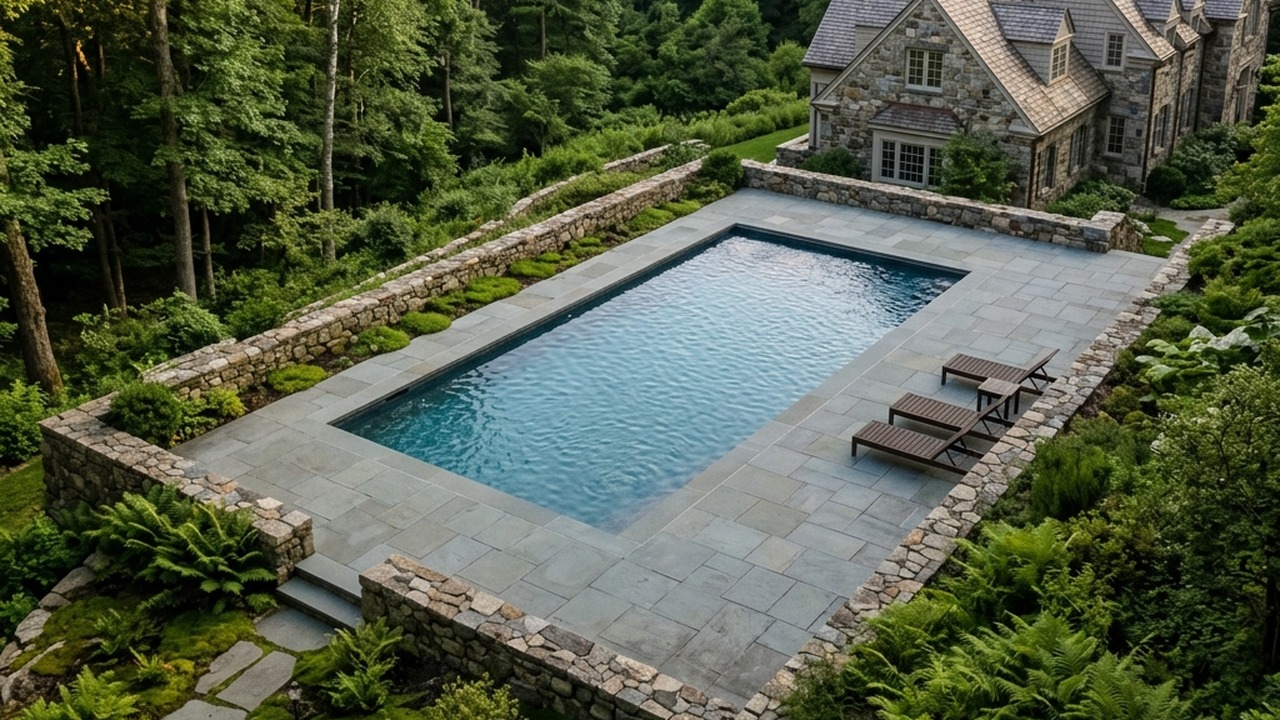
- Woodland pools with natural stone coping, boulder features, and organic shapes that integrate with Wilton's forested landscape, appearing as natural clearings within the property
- Vanishing edge pools on hillside properties along Belden Hill, Drum Hill, and the Georgetown ridgelines, where elevation allows dramatic visual effects overlooking wooded valleys
- Traditional formal pools with Pennsylvania bluestone coping and raised spillover spas for Wilton's Colonial and Georgian estates, balancing classic proportions with modern amenities
- Pool and outdoor living complexes with fire features, built-in seating, and entertainment terraces for properties where the pool anchors a comprehensive backyard design
- Pool renovations for aging installations that need structural repair, new surfaces, updated mechanical systems, or complete aesthetic transformation
Why Wilton Homeowners Choose Gedney Pools
Based in neighboring Darien, Gedney Pools operates minutes from Wilton and understands the town's character thoroughly. We recognize that a pool on a two-acre wooded lot in Wilton requires a fundamentally different approach than a pool on a half-acre waterfront property in Rowayton or a four-acre estate in backcountry Greenwich. The design must respond to the site, the architecture, and the owner's vision for how the pool functions within the larger landscape.
We manage every aspect of the project -- design, engineering, permitting, and construction -- personally, at every phase. Custom pool construction in Wilton starts at $200,000 and goes up from there, depending on scope, site conditions, and the complexity of surrounding features. Construction timelines run 12 to 18 weeks, with permitting adding 4 to 8 weeks.