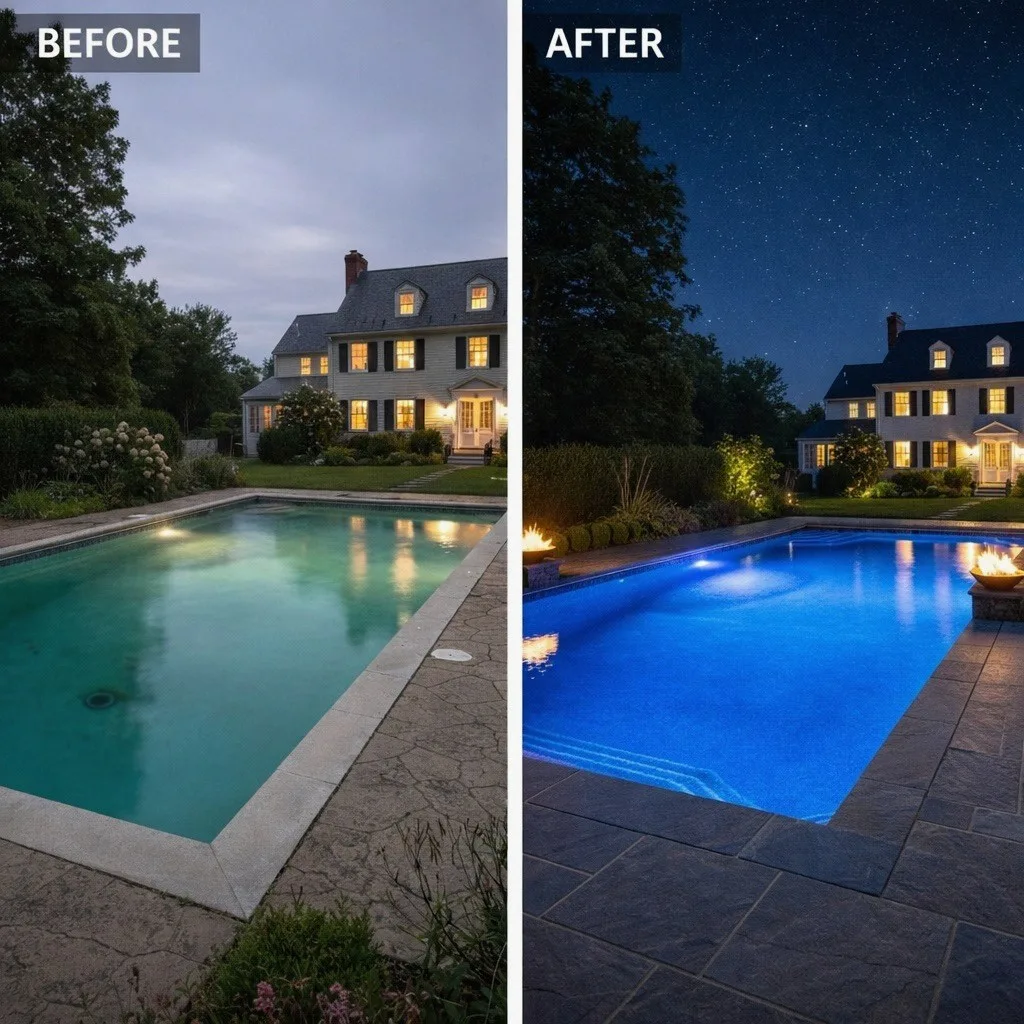
The five signs your vinyl pool is ready for gunite conversion
- You have already replaced the liner twice. Each liner replacement is $7,000 to $14,000 and an entire spring lost to draining and refilling. A third liner replacement on a 30-year-old pool is throwing money at a depreciating asset.
- The bond beam or walls are failing. Cracking, settlement, or wall bow that an inspection diagnoses as structural -- not cosmetic -- means the shell is at end of life. A vinyl pool with a failing bond beam is rebuild territory, not patch territory.
- The equipment is at end of life. Pumps, filters, and heaters from the original 1990s install are now 25-30 years past their service life. A full equipment refresh is $15,000 to $35,000. If you are doing that anyway, the conversion question becomes "for incremental cost, what do I get."
- You want design changes a vinyl pool cannot accommodate. Custom shape, vanishing edge, integrated raised spa, sun shelf, deeper end, raised beam, infinity wall: all are gunite-only. If the redesign is the goal, conversion is the path.
- You are doing a full landscape renovation anyway. If the deck, hardscape, and planting are being redone, this is the moment to redo the pool too. Doing them separately means tearing up new hardscape later for pool work.
When NOT to convert
If the vinyl shell is sound, the equipment was refreshed within the last 8 years, and you are happy with the shape and depth: re-line and run it. A new liner on a sound vinyl pool gives you another 10-15 years for $10,000-$14,000. Conversion at that point is a luxury purchase, not a maintenance decision.
If the lot is constrained by setbacks or zoning to the existing pool footprint and you cannot enlarge or reshape: conversion still works but a significant share of the design upgrade value is lost. Discuss with the builder before committing.
Real cost components of a CT vinyl-to-gunite conversion
| Line item | Typical 2026 CT range |
|---|---|
| Demolition: vinyl liner, panels, coping, deck removal | $12,000 - $32,000 |
| Excavation expansion (if reshaping or deepening) | $8,000 - $35,000 |
| Structural steel + dowels (sized to engineered drawings) | $15,000 - $40,000 |
| Gunite shell shoot | $32,000 - $75,000 |
| Plumbing rebuild (reuse stub-outs where possible) | $14,000 - $40,000 |
| Electrical + bonding + automation | $12,000 - $35,000 |
| Equipment refresh (pump, filter, heater, sanitation) | $15,000 - $45,000 |
| Tile + coping + finish | $32,000 - $90,000 |
| Stamped PE drawings + permit + inspection fees | $5,000 - $14,000 |
| Autocover (if added) | $18,000 - $32,000 |
| Deck replacement (often a separate masonry contract) | $25,000 - $90,000 |
A typical Fairfield County vinyl-to-gunite conversion starts at $200,000 all-in and goes up from there. The lower end is a like-for-like footprint with standard finish and reused equipment pad location. The upper end is a full redesign with shape change, depth change, autocover, and premium finish.
The 8-step conversion process
- Site walk + scope conversation. Walk the existing pool with the builder. Identify what is reusable (equipment pad location, electrical service, gas line, water service), what is not (vinyl panels, liner, old equipment).
- Design. If shape, depth, or features are changing, design the new pool from scratch. If keeping the existing footprint, design to the existing excavation.
- Engineering. Stamped PE drawings for the new gunite shell. Conversion shells require the same engineering rigor as a new build.
- Permit. New permit application to the town building department. Treated as new pool construction, not renovation.
- Demolition. Vinyl liner, panels, coping, and bond beam removed. Equipment pad disconnected. Deck typically removed unless protected.
- Construction. Same sequence as a new gunite pool: excavation (if expanding), steel, plumbing rough, gunite shoot, cure, tile, coping, finish.
- Equipment + electrical. New equipment installed. Bonding and electrical to current NEC 680.26 standard.
- Startup + handoff. First fill, chemistry balance, equipment commissioning, owner walkthrough.
The hidden bonus: code upgrade
A 1990s vinyl pool was built to 1990s code. Conversion brings the new pool to current code: barrier requirements, bonding (NEC 680.26), suction-entrapment compliance (APSP-7 + VGB), autocover acceptance (ASTM F1346 listed). For homeowners selling within 5-10 years, current code compliance is a real selling point. For homeowners staying long-term, current code compliance is a real safety improvement.
What we will not do
- "Convert" by overlaying gunite onto an existing vinyl shell. Not structurally sound, not code-compliant, not warrantable. Anyone offering this is offering you a future failure.
- Convert without new engineering drawings. The new gunite shell needs its own stamped drawings. Reusing a 30-year-old plan does not meet current code.
- Skip the new permit. CT towns require it. Skipping it creates a non-compliant pool that is invisible to the town until a future inspection, sale, or accident exposes it.
Frequently asked questions
Q: When does conversion make sense?
When the liner has been replaced 2+ times, the shell is failing, the equipment is at end of life, or the homeowner wants design changes that vinyl cannot accommodate.
Q: How much does it cost?
$200,000 and up in CT in 2026, and still less than a brand-new gunite build because excavation and utility lines often already exist.
Q: How long does it take?
5 to 9 months from contract to first fill, depending on permit cycle and gunite shoot weather window.
Q: Do I need a new permit?
Yes. CT towns treat conversion as new pool construction permit, not renovation, because the structural system is being replaced.
Q: Can I change the shape, depth, or add features?
Yes. Conversion is the ideal time for design upgrades because the shell is being rebuilt from scratch. Common additions: integrated spa, sun shelf, deeper end, vanishing edge, autocover, premium finish.
Talk through whether conversion is right for your pool
If you have a vinyl pool that is starting to feel like it is costing more to keep than it would cost to replace, the right starting point is a site walk. I will look at the shell, the equipment, the deck, and the lot, and tell you honestly whether you need a new liner, a full conversion, or somewhere in between.
John Gedney
Owner, Gedney Pools, LLC
(203) 302-9920
john@gedneypools.com
Darien, CT
CT HIC #0704131 | CT SPB #SPB.0000169
Internal links: Pool renovation · Custom gunite construction · Gunite vs vinyl vs fiberglass · Cost to build gunite pool CT · Pool permits