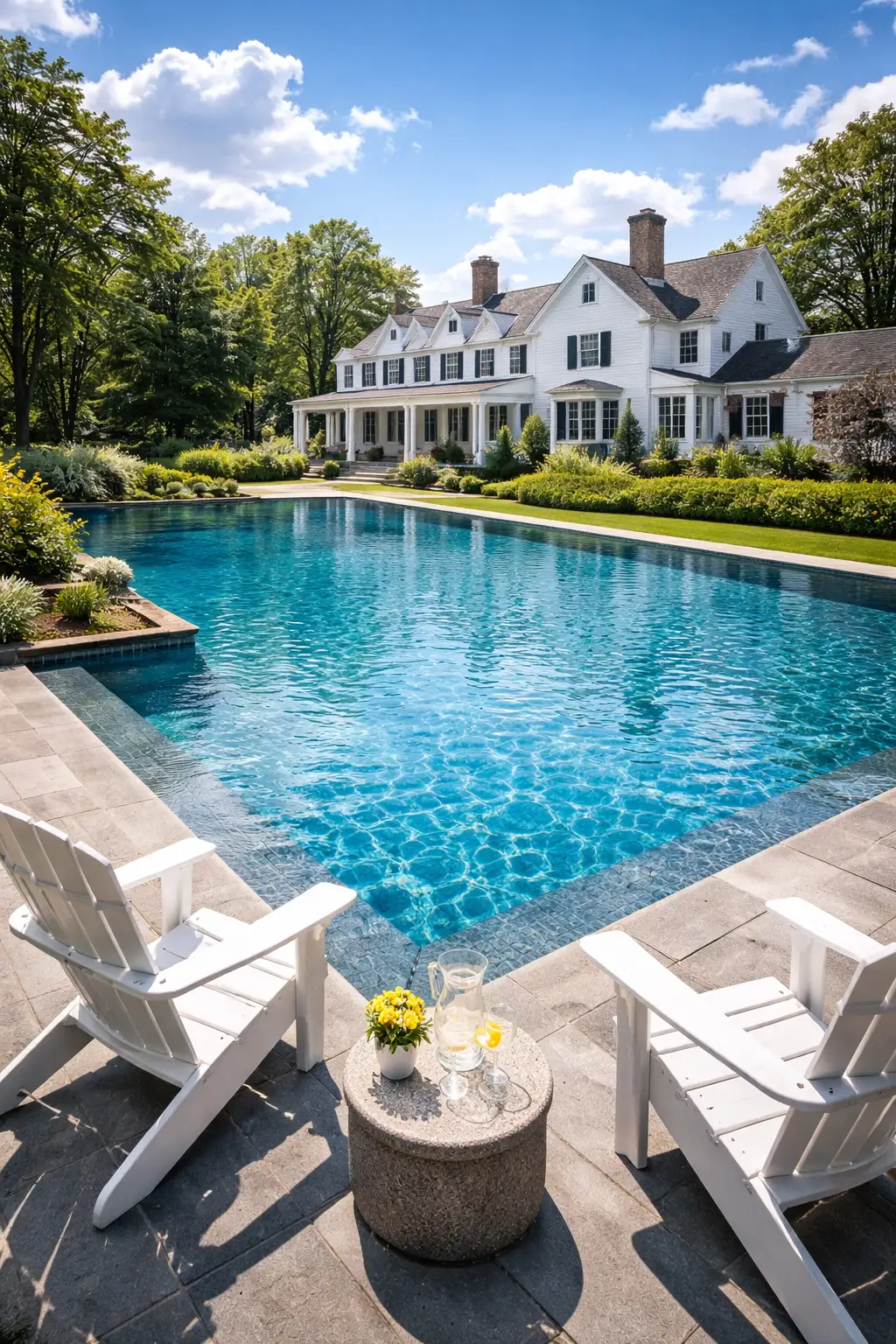
The 7-step Darien pool permit process
- Design and engineering package preparation. Pool site plan, structural drawings, equipment plan, electrical plan, plumbing plan, barrier plan, suction-entrapment compliance documentation, and erosion control plan. For custom gunite, stamped PE drawings are required.
- Pre-application coordination. A good builder coordinates with the Darien Building Department, Health Department, and Inland Wetlands office before submission to surface any site-specific requirements. This conversation saves 4 to 8 weeks of rework.
- Wetlands and zoning review. If the property is within 100 feet of a regulated wetland or watercourse, Inland Wetlands jurisdiction applies. Setback variances, if any, go through the Zoning Board of Appeals.
- Building permit submission. Full package submitted to the Building Department with construction cost basis, contractor licenses, and insurance certificates. Application fee due at submission.
- Plan review. Building Department reviews the package against the 2022 CT State Building Code, the 2018 ISPSC adopted by reference, NEC 680 (NFPA 70 2020), APSP-7 and APSP-16, the federal VGB statute, CGS §52-572a, and Darien-specific zoning. Comments come back within 2 to 6 weeks.
- Issued permit. Permit issued after plan review approval. Construction can start. Inspection card lists the gates the project must pass.
- Inspection sequence and CO. Construction proceeds through the inspection gates (see below) to final and certificate of completion.
Real fees in Darien, 2026
| Fee | Typical 2026 range |
|---|---|
| Building permit (pool construction) | $1,200 - $3,800 |
| Electrical permit | $300 - $900 |
| Plumbing permit | $250 - $700 |
| Health Department review (if applicable) | $150 - $500 |
| Inland Wetlands application (if applicable) | $400 - $1,500 |
| Zoning Board variance application (if needed) | $400 - $1,200 |
| State CT education fee (% of permit) | varies |
Most residential gunite pool projects in Darien land in the $1,800 to $5,500 total permit fee band, before wetlands or variance work. Verify current fee schedule with the Darien Building Department.
The Connecticut code framework for residential pools (current statutory citations)
Connecticut residential pool permitting derives from a stack of statutes, codes, and standards. Cite these accurately and you will not be tripped up by an inspector. The current framework as of 2026:
- CGS §29-251 et seq. -- Connecticut State Building Code authorizing statute. The Office of the State Building Inspector under DAS publishes the adopted code edition.
- 2022 Connecticut State Building Code -- current adopted edition, effective October 1, 2023. Based on the 2021 ICC family (IBC, IRC, IECC, IMC, IPC, IFGC) with Connecticut-specific amendments. The 2022 CT State Building Code remains in force in 2026 -- there is no annual amendment cycle; the next anticipated update is the 2025 CT State Building Code (timing TBD by the State Building Code Committee).
- 2022 Connecticut State Fire Safety Code -- current adopted edition, effective October 1, 2023. Pool barrier and equipment-room fire code requirements come from here.
- CGS §52-572a et seq. -- Connecticut residential pool safety statute. Establishes the statutory duty of care for residential pool barrier compliance.
- 2018 International Swimming Pool and Spa Code (ISPSC) -- incorporated by reference into the 2022 CT State Building Code. Replaces references to the older 2015 IPC. Sections G304 (barriers) and 305 (entrapment protection) are the load-bearing pool sections.
- NEC 680 (NFPA 70, 2020 edition) -- incorporated by reference for all pool electrical, including the §680.26 equipotential bonding requirement detailed in the next section.
- ASTM F1346-91 (2018) -- the listing standard for an automatic pool cover used as the primary safety barrier. The autocover-as-barrier path discussed below requires this listing.
- Virginia Graeme Baker Pool and Spa Safety Act (VGB, 15 USC §8001 et seq.) -- federal anti-entrapment statute. Applies to every residential pool drain in the United States.
- APSP-7 and APSP-16 -- American National Standards for suction-entrapment compliance and barrier classification, referenced by the ISPSC.
The bottom-line working summary for a Darien residential pool barrier:
- 48-inch minimum barrier height measured from the outside finished grade.
- 4-inch maximum sphere openings in any barrier (no climbable footholds, no horizontal cross members within reach from outside).
- Self-closing, self-latching gates opening outward away from the pool, with latch height at 54 inches minimum.
- House wall as part of the barrier permitted only with code-compliant alarms on doors that open directly to the pool area, or with a power safety cover (autocover).
- Power safety cover (autocover) as primary barrier permitted if ASTM F1346 listed and operational at all times. Most Darien builds use this path.
NEC 680.26 bonding (the line item every Darien homeowner overlooks)
National Electric Code 680.26 requires equipotential bonding of every metallic component within five feet of the water and below 12 feet above maximum water surface. In a Darien pool that means:
- The full pool steel reinforcement grid, tied to bonding
- Coping anchors, ladder anchors, handrail anchors
- Autocover track and motor assembly
- Equipment pad (pumps, filters, heaters all bonded to a common point)
- Any metal fixture, light, drain cover, or grate
- Any structural steel within 5 feet of the water (fence posts, pergola posts)
Bonding is inspected before gunite (at pre-gunite inspection) and again at electrical rough. A missed bonding connection is a re-inspection. A re-inspection is a delay. A delay through October pushes the gunite shoot into the winter weather window. This is why bonding matters more than it sounds like.
APSP-7 and VGB suction-entrapment compliance
Federal Virginia Graeme Baker Pool and Spa Safety Act and APSP-7 require:
- VGB-listed drain covers on every suction outlet
- Dual-drain hydraulics on any single-pump system (paired drains separated by at least 3 feet)
- Drain face velocity within the listed limits
- Pipe-size velocity caps on suction lines
- Anti-entrapment safety vacuum release if a single drain configuration is used
Darien inspectors check VGB compliance at plumbing rough and again at final. The compliance documentation is part of the permit package.
Autocover-as-barrier path in Darien
Darien accepts an ASTM F1346 listed automatic pool cover as the primary safety barrier. The autocover-as-barrier path requires:
- F1346 listed manufacturer (the major automatic cover systems all carry F1346 listings)
- Cover operational at all times when the pool is not in active use
- Code-compliant alarms on doors that open directly to the pool area (most often the back door of the house)
- Manufacturer install or trained-installer install; the cover is on the inspection card
For a Darien homeowner who does not want a fence, the autocover-as-barrier path is usually the right answer. The autocover also pays back in heat retention, water-loss reduction, debris control, and chlorine demand.
Inspection sequence in Darien
- Pre-gunite inspection. Steel cage, plumbing pressure test, bonding, hydraulic layout. Must pass before gunite is shot.
- Electrical rough. Equipment pad wiring, bonding continuity check, lighting circuits, GFCI verification.
- Plumbing rough. Equipment pad plumbing, hydraulic test, VGB drain compliance.
- Pre-deck inspection (where applicable). Bonding continuity around coping and any deck steel, expansion joint detail.
- Barrier inspection. Autocover installation, alarm certification, or fence and gate compliance.
- Final inspection. Full system operating, certificate of completion.
What slows a Darien permit down
- Incomplete package on first submission. Missing electrical plan, missing barrier plan, missing PE stamp. Adds 2 to 4 weeks.
- Wetlands proximity not flagged early. Discovered mid-review, sends the project to Inland Wetlands. Adds 4 to 8 weeks.
- Setback variance discovered after submission. Adds 6 to 10 weeks for ZBA cycle.
- Unstamped drawings. Custom gunite, vanishing edge, sloped lot, or deep pool needs PE stamps. Adds whatever the engineering cycle takes.
- Contractor license documentation missing. CT HIC and SPB must be current and on file. We carry CT HIC #0704131 and CT SPB #SPB.0000169.
Frequently asked questions
Q: How long does a Darien pool permit take?
6 to 12 weeks for a clean submission, 12 to 20 weeks with wetlands or variance review.
Q: What does the permit cost?
$1,800 to $5,500 total for a typical residential pool project, before wetlands or variance fees.
Q: Does Darien accept an autocover as the barrier?
Yes, with ASTM F1346 listing and code-compliant alarms on doors opening directly to the pool area.
Q: Do I need a structural engineer?
Yes for any custom gunite, vanishing edge, sloped lot, ledge rock site, or pool deeper than 6 feet.
Q: What is the setback requirement?
Typically 10 feet minimum from any property line, with additional setbacks from structures, septic, and wetlands. Verify for your specific lot.
Q: Do I need a landscape architect or just a pool builder for a Darien pool?
A landscape architect adds value on integration-heavy projects where pool, hardscape, planting, and house elevations must work together. For a clean rectangular pool with a simple deck, a builder-led design works fine. For vanishing edge, sloped lots, or complex new-construction integration, expect to engage a landscape architect alongside the pool builder.
Q: How does Darien's wetlands review work for pool projects?
If any part of the pool, excavation footprint, or stormwater runoff is within 100 feet of a regulated wetland or watercourse, Darien Inland Wetlands has jurisdiction. The wetlands application adds 4 to 8 weeks. Wetland delineation by a licensed soil scientist may be required. Lots near the Five Mile River or Noroton River often trigger this review.
Talk through your Darien pool permit before design lock
The permit conversation should happen before design lock, not after. A clean permit package saves 4 to 12 weeks on the construction calendar, and a permit-aware design avoids the variance and re-design cost that homeowners get blindsided by.
If you are evaluating a pool build in Darien, I am happy to walk through the permit profile of your specific lot before any drawings are produced.
John Gedney
Owner, Gedney Pools, LLC
(203) 302-9920
john@gedneypools.com
Darien, CT
CT HIC #0704131 | CT SPB #SPB.0000169
Internal links: Pool permitting service · Pool builder Darien CT · Automatic pool covers · Autocover safety integration · Pool permits in Darien