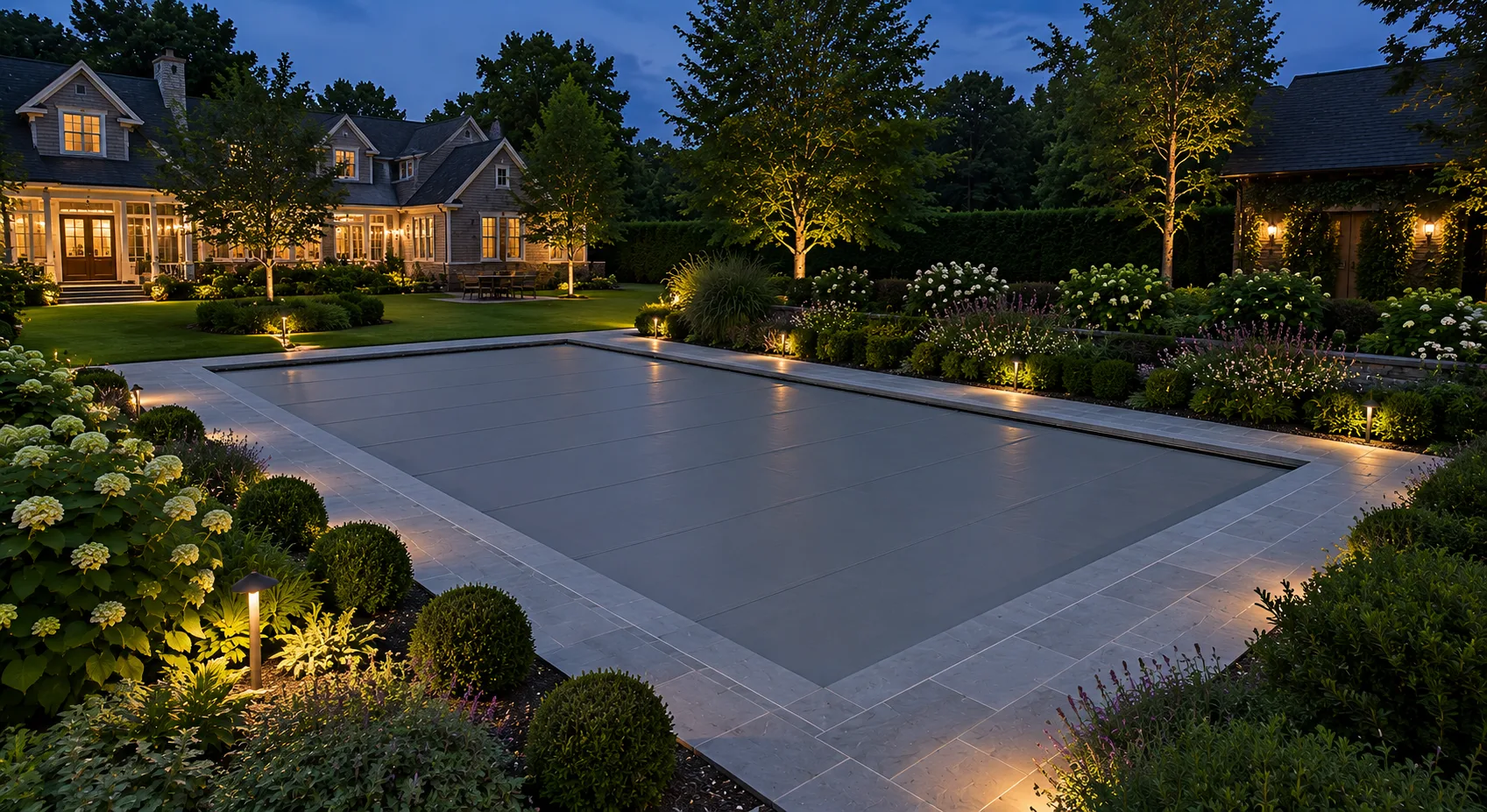
The CT code story (and why it matters)
Connecticut residential pool code derives from the 2015 International Pool & Spa Code by reference, the CT State Building Code, and the CT residential pool safety statute. The code requires every residential pool to have a primary safety barrier. The barrier can be:
- A 48-inch four-sided fence with self-closing self-latching gates and 4-inch maximum opening spacing
- An ASTM F1346 listed automatic pool cover with code-compliant door alarms on house doors opening to the pool area
- A combination where the house wall is part of the barrier plus an autocover
Most CT towns (Darien, Greenwich, New Canaan, Westport, Stamford, Norwalk, Wilton, Ridgefield) accept the autocover-as-barrier path. A few smaller towns interpret the code more conservatively and require a fence in addition to the autocover. Always confirm with the specific town building department before design lock.
Why most CT custom pool buyers choose the autocover path
- Sight lines. A 48-inch fence around the pool obstructs the architectural view that the homeowner just paid for. The autocover preserves the view.
- Heat retention. A closed autocover retains 50-70 percent of heating cost. In CT's shoulder seasons (April-May, September-October), this extends usable pool season by 4-8 weeks per year.
- Evaporation reduction. 90+ percent less evaporation = significantly less water replacement and chemical addition. Operating cost drops measurably.
- Debris exclusion. Leaves, twigs, and surface debris stay off the water. Skimmer load drops. Cleaning labor drops.
- Code compliance. Single-system barrier compliance instead of fence + alarms + manual cover.
Coverstar vs Aquamatic: real field comparison
Both are ASTM F1346 listed, both are widely installed in CT, both work. The differences are slight and accumulate over 20 years.
| Dimension | Coverstar | Aquamatic |
|---|---|---|
| Track durability | Slight edge (heavier aluminum extrusion) | Comparable, sometimes more flexible mount options |
| Motor reliability | Reliable, 12-15 year typical run | Reliable, 12-18 year typical run |
| Cover fabric life | 7-10 years in CT | 8-12 years in CT |
| Track style options | Under-coping, top-mounted | Under-coping, top-mounted, recessed |
| CT dealer network | Stronger | Adequate |
| Cost (2026 CT install) | $18,000-$32,000 | $19,000-$34,000 |
| Cover replacement (years 7-10) | $4,500-$7,500 | $5,000-$8,500 |
The honest answer: the brand matters less than the installer. A correctly installed Coverstar will outperform a poorly installed Aquamatic, and the reverse. Ask your builder which brand they have the longest install history with and let that drive the selection.
Install considerations on a custom CT pool
Cover box location. Most CT custom pools place the cover box at the shallow end, under the coping, hidden from view. On a vanishing edge pool, the box typically goes at the opposite end from the weir. Box placement is locked in at the gunite phase — change after that is expensive.
Track style. Under-coping tracks are invisible and the preferred high-end install. Top-mounted tracks are visible and slightly less expensive. Recessed tracks (Aquamatic specific) sit flush with the deck for a clean look at the cover edge.
Motor placement. Hydraulic motors run quieter than electric in our experience and are preferred on luxury installs where the equipment room is near the pool. Electric motors are simpler and adequate on most installs.
Bonding. The autocover track and motor are part of the NEC 680.26 equipotential bonding system. The bonding tie is inspected before gunite and verified at electrical rough. Skipping this bond is a code violation and a real safety risk.
Cover fabric selection. Multi-year UV exposure in CT favors heavier mesh weights. Cheap covers fail at year 4-5. Premium covers run 9-12 years. The upgrade is $1,500-$3,000 at install and pays back well before first replacement.
What can go wrong over 20 years
- Track corrosion. Salt water pools accelerate aluminum track corrosion. Stainless steel screws and proper drainage in the track channel matter more on salt systems.
- Drive cable wear. Cables stretch and fray. Service interval is typically 8-12 years.
- Motor bearing wear. 12-18 years. Bearings replaceable without full motor swap on most current models.
- Cover fabric UV degradation. 7-12 years depending on cover weight, sun exposure, and CT pollen/sap load. Cover replacement is the most predictable line item.
- Falling-debris damage. Heavy tree branches in storms. Insurance-covered usually but cover replacement is the typical fix.
What we tell every CT custom pool buyer
If your lot can accept an autocover-as-barrier under the local town code, install one. If your design intent is unobstructed sight lines, the autocover is the only way to achieve them without violating code. If you are heating the pool past September or before May, the autocover is the difference between $6,000 and $12,000 of annual heating cost. If you are running a custom finish that benefits from stable water chemistry, the autocover keeps the chemistry stable.
The autocover is not a "would be nice" line item on a CT custom pool. It is the primary safety system, the primary operating cost saver, and one of the top three resale features.
Frequently asked questions
Q: Does CT accept an autocover as the required barrier?
Yes in most towns (Darien, Greenwich, New Canaan, Westport, Stamford, Norwalk). The cover must be ASTM F1346 listed and operational at all times when the pool is not in active supervised use. House doors opening to the pool must have code-compliant alarms.
Q: Coverstar vs Aquamatic — which is better?
Both are reliable F1346 systems with comparable safety profiles. The installer matters more than the brand. Use whichever your builder has the longest install history with.
Q: How much does it cost?
$18,000 to $32,000 in 2026 on a new CT custom pool. Retrofit on an existing pool is more expensive due to coping modifications.
Q: How long does an autocover last?
Cover fabric: 7-10 years. Motor/drive/track: 12-18 years with regular maintenance.
Q: Does it actually save heating and chemical costs?
Yes, significantly. 90+ percent less evaporation, 50-70 percent heating cost savings, 4-8 weeks extended pool season per year.
Talk through autocover selection for your Connecticut pool
If you are evaluating an autocover for a new custom pool or considering retrofit on an existing one, the conversation starts with the local town code and the architectural goals. I will walk through what your town accepts, what makes sense for your pool shape and lot, and which brand-installer combination is the right call.
John Gedney
Owner, Gedney Pools, LLC
(203) 302-9920
[email protected]
Darien, CT
CT HIC.0704131 | CT SPB.0000169
Internal links: Automatic pool cover service · Luxury pool safety + autocover integration · CT pool permits + barrier code · Custom gunite construction